
DEAD AHEAD Guide: Joining a ship and picking a role
About
OverviewDEAD AHEAD is a naval combat game where two fleets fight across randomized maps using guns, torpedoes, and carrier aircraft. Up to 70 players split roles across destroyers, cruisers, battleships, and carriers — each ship needs a captain, gunners, and support crew to function. This guide covers how to join a ship, what each role does, how to fight effectively, and how the win-based progression system works.
What is on this page
Contents
Joining a ship and picking a role
Step
At the start of each round, click a ship icon on the map to join that vessel's crew. You can switch factions mid-game by typing !changeteam in chat, and if a player is causing problems you can start a vote with !votekick [username].
- Sit in the right seat captains steer, rangefinder operators spot distances, and gunners fire the turrets; leaving any seat empty weakens the ship.
- Switch teams type !changeteam in chat if you end up on the wrong side.
- Votekick troublemakers type !votekick [username] to start a ten-second community vote.
Gunnery and rangefinding basics
Tips
Every shell in the game has a set velocity and drops over distance, so you must aim ahead of moving targets and adjust elevation manually. Rangefinders tell gunners the correct elevation; without one, battleship crews can fire tracer flares with G to spot the range themselves, though flares also reveal your position. Turrets use X to enter crosshair mode, Shift for precise slow traversal, and F to fire — the gun reloads automatically after each shot.
- Target the bridge to knock out both steering and fire control at once, buying your torpedo operators a clear window to shoot.
- Target main turrets to strip the enemy of their heaviest firepower, even temporarily.
- Lead moving ships — if the rangefinder reads 10.5 and the enemy is closing, aim closer to 10.3 to account for travel time.
- Avoid micro-turns while sailing; constant small course changes ruin your gunners' aim.
- Use tracer flares sparingly — they expose your battleship's position to enemy gunners.
Ship classes and how to play each one
Table
The fleet in any given round can include destroyers, light and heavy cruisers, anti-aircraft cruisers, battleships, and carriers.
| Destroyer | Avoid battleships entirely since two full salvos can sink you. |
| Light Cruiser | Pair with a second light cruiser; combined reload rates produce deadly sustained fire against any target. |
| Heavy Cruiser | Broadside to bring all main guns and half your secondaries to bear; never rush a battleship at close range. |
| Anti-Aircraft Cruiser | Park in a wedge in front of your carrier to block torpedoes and shoot down incoming planes before they release their payload. |
| Battleship | Stay at long range, broadside the enemy, and use scout planes or tracer flares to mark targets before firing. |
| Carrier | Keep it at a map corner or behind an island whenever the enemy has battleships, and manage your aircraft carefully since planes are limited. |
Aircraft roles and when to use each one
CheckPlanes are finite on each carrier, so losing one carelessly hurts your whole team. Return to a friendly carrier and press R to resupply ammunition. Kamikaze attacks should only happen in genuine last-resort situations.
- Fighter (press X for crosshair mode): shoot down enemy aircraft first, then strafe exposed deck crew bullets do very little damage to the hull itself.
- Dive bomber climb above the clouds, then dive steeply and use the built-in crosshair to land bombs directly on enemy main turrets.
- Attack aircraft use rocket payloads to start fires on ships.
- Torpedo bomber: fly low and at full speed, release torpedoes well ahead of the target, and expect the payload to be slow lead aggressively.
- Scout / floatplane range-find for the heaviest guns available; you can land on water, but sitting still makes you an easy target.
- All aircraft do not kamikaze unless your carrier is gone and resupply is impossible, or your plane is about to be destroyed before you can return.
Fighter maneuvering in a dogfight
Tips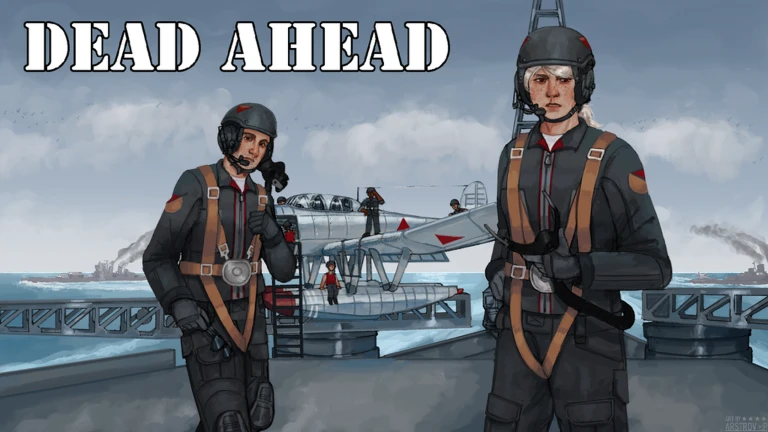
Fighters have a top speed of 300 studs per second and a wider turning circle than attack aircraft.
- Roll your plane 45 degrees left or right, then press the direction key and hold pitch-up — this hard turn is faster than a flat turn.
- Getting below your opponent is more advantageous than being above them; a lower position gives you more time to maneuver before overshooting.
- If an enemy is on your tail, reduce throttle and roll to make them overshoot, then counter-attack.
- Manage your throttle actively — slow down to tighten your turn radius, speed up to break out of someone's sights.
- Target enemy fighters before going after attackers.
- If you run out of ammo and your carrier is gone, use your speed to trail enemy ships and report their position to your team.
Skirmish and Dreadnought game modes
Summary
Skirmish is the most common mode: two fleets of three to five ships fight with no time limit until one side is completely sunk. Dreadnought narrows this to one large dreadnought plus two destroyer escorts per side, and only the dreadnought's survival matters.
- Skirmish goal sink every enemy warship; the mode has no clock so take time to coordinate.
- Dreadnought goal destroy the enemy dreadnought; escort destroyers are expendable but useful for scouting and flanking.
- Early-game rule keep the fleet together so combined anti-air fire protects against aircraft attacks.
- Battleship positioning always move to the open side of the map for maximum firing lines.
- Carrier positioning hide at a map corner or behind an island whenever enemy battleships are active.
- Dreadnought helmsman do not dodge incoming torpedoes; the sudden course change ruins your gunners' aim more than the hit would.
Win badges and cosmetic rewards
TableWins are tracked automatically and badges are awarded at set thresholds. The NCO cosmetic unlocks at 100 wins and the Officer cosmetic at 500 wins; no other badge in the current list grants a cosmetic reward.
| Badge | Wins needed | Cosmetic reward |
|---|---|---|
| FIRST WIN | 1 | None |
| SEAMAN | 50 | None |
| PETTY OFFICER | 100 | NCO cosmetic |
| WARRANT OFFICER | 150 | None |
| ENSIGN | 250 | None |
| LIEUTENANT | 500 | Officer cosmetic |
| COMMANDER | 750 | None |
| CAPTAIN | 1000 | None |
| REAR ADMIRAL | 2000 | None |
Glossary
Glossary- Rangefinder
- A crew seat that measures distance to enemy ships and feeds gunners the correct elevation to hit them.
- Broadside
- Turning the full side of your ship toward the enemy so that both front and rear turrets can fire at the same time.
- Tracer flare
- A battleship tool fired with G that marks an enemy target's range for your gun crews, at the cost of revealing your own position.
- Skirmish
- The standard game mode in which two fleets fight with no time limit until one side has all its ships sunk.
- Dreadnought mode
- A game mode where each team fields one large dreadnought and two destroyers; only the dreadnought's destruction ends the match.
- Hard turn
- A faster-than-normal aircraft turn done by rolling 45 degrees and then pulling up while pressing the direction key.
- Hull classification code
- A shorthand label for ship types — BB for battleship, CA for heavy cruiser, CVL for light carrier, DD for destroyer, and so on — used by experienced players in team chat.
Common questions
FAQHow do I switch teams after I've already spawned?
Type !changeteam in the chat box and press Enter.
My plane ran out of ammo — what do I do?
Fly back to a friendly carrier and press R while on or near it to resupply.
Our ship only has a few crew members — can we still fight?
On ships where the captain's seat and the rangefinder seat are close together, the captain can move between both roles. Keep in mind that while the captain is ranging, nobody is watching for torpedoes.
When is it worth doing a kamikaze attack?
Kamikaze is a last resort — use it when your carrier is gone and resupply is impossible, or when your plane is about to be destroyed before you can reach safety.
Game updates can change what is on this page. If you spot something, get in touch and let us know.