gameboysix's Nonogram Guide: How a nonogram works
About
Overviewgameboysix's Nonogram is a multiplayer puzzle game where up to four players work together to solve nonogram grids. You fill in tiles based on number clues along the edges of the grid — sometimes called Picross, Hanjie, or Gridlers.
What is on this page
Contents
Player notes and tips
Found a useful trick? Share it with everyone! Notes with screenshots are welcome!
Write a guide note
gameboysix's Nonogram
How a nonogram works
Check
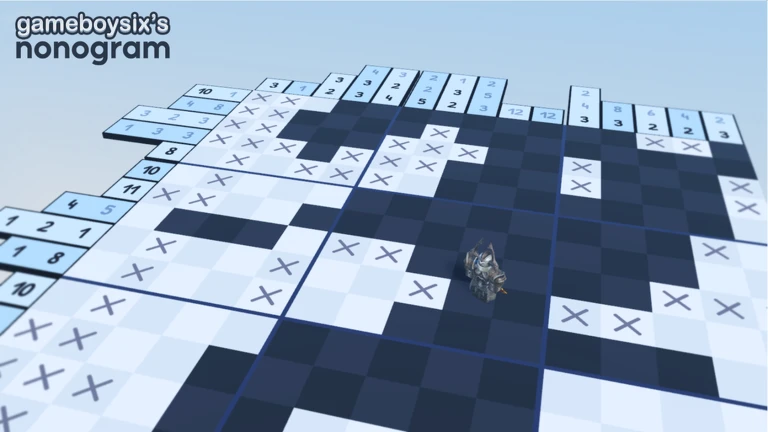
The numbers along the edges tell you how many tiles in a row to fill in, and in what order. A clue like '3 2' means a run of three filled tiles, then a gap, then a run of two — in that exact sequence. Once every tile in the grid is correctly filled or crossed out, the puzzle is complete.
- Each number clue the length of one continuous run of filled tiles in that row or column.
- Multiple numbers those runs appear in the order listed, with at least one empty tile between each.
- Crossing out tiles mark any tile you are sure should stay empty; this narrows down what remains.
- Dot memos a private mark only you can see, useful for tracking possibilities mid-solve.
MetaNew Player Survey

The next survey is being prepared.
Controls for every device
TableThe game supports a keyboard and mouse, a touchscreen, and a controller. Switching between fill mode and cross mode is central to how you play.
| Keyboard | press Q or F, or click a button, to switch modes; click and drag over tiles to fill or cross them. |
| Keyboard dot memo | hold E and drag over tiles to place dots visible only to you. |
| Touchscreen | tap the on-screen buttons to switch modes. |
| Controller | press LB or RB to switch between modes. |
Starting out
Step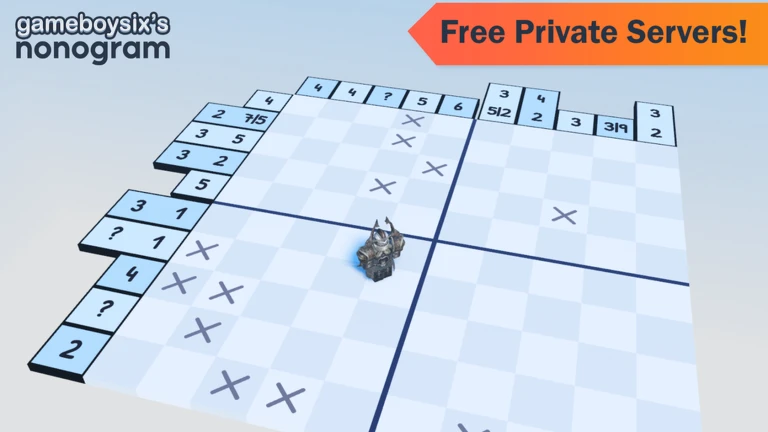
The tutorial walks you through the rules and controls from scratch. Finishing it earns you the Graduate cross mark as a permanent reward.
- Play the tutorial finish it to earn the Graduate cross and lock in the basics.
- Try co-op invite up to three friends to tackle the same puzzle together; private servers are free.
Badge progression
TableWin badges stack as you solve more puzzles. Size badges require you to complete a grid at least that wide and tall, and you must actually win the round for the badge to count.
| Badge | What you need to earn it |
|---|---|
| 1 Win | Win your first puzzle |
| 10 Wins | Win 10 puzzles total |
| 100 Wins | Win 100 puzzles total |
| 1000 Wins | Win 1,000 puzzles total |
| 10k Wins | Win 10,000 puzzles total |
| 100k Wins | Win 100,000 puzzles total |
| Solved 20x20 | Win a puzzle on a grid 20 tiles wide and 20 tiles tall or larger |
| Solved 30x30 | Win a puzzle on a grid 30×30 or larger |
| Solved 40x40 | Win a puzzle on a grid 40×40 or larger |
| Solved 50x50 | Win a puzzle on a grid 50×50 or larger |
| Solved 60x60 | Win a puzzle on a grid 60×60 or larger |
| Solved 70x70 | Win a puzzle on a grid 70×70 or larger |
Earning the MVP badge
Tips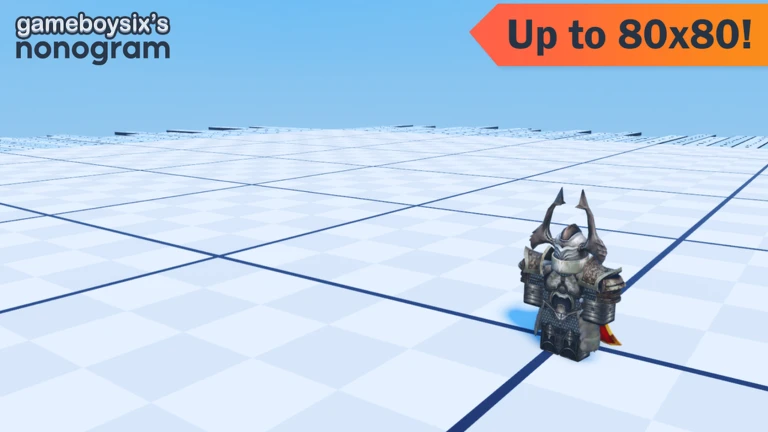
The MVP badge is awarded at the end of a round to the single player who operated the most tiles — fills and crosses both count toward the total.
- You need at least three players in the round for MVP to be awarded.
- Crossing out empty tiles counts the same as filling in solid tiles, so process both confidently.
Time badges
SummarySix badges track how long you have spent in the game. The highest of them represents nearly 42 days of total play time.
- 1 Hour badge one hour played
- 10 Hours badge ten hours played
- 100 Hours badge one hundred hours played
- 1000 Hours badge one thousand hours played, roughly 42 days total
Glossary
Glossary- Nonogram
- A logic puzzle where you fill in tiles on a grid based on number clues along each row and column; also called Picross, Hanjie, or Gridlers.
- Graduate cross
- A special cross mark awarded when you complete the tutorial.
- Dot memo
- A private marker you place on a tile as a personal note while solving; no other player can see it.
- MVP
- The badge given to the player who fills or crosses the most tiles in a round that has three or more participants.
- Solver
- A program that works out a nonogram automatically; their use is banned in this game.
Common questions
FAQDo private servers cost anything?
Private servers are completely free.
Can other players see my dot memos?
Dot memos are visible only to you. Place them freely as working notes while you reason through a grid.
How many people can play in one room?
Up to four players can work on the same puzzle at once. You need at least three in a round for the MVP badge to be in play.
Do I need to win a round for the size badges to count?
Yes. Completing a 20×20 or larger grid only earns the corresponding badge if the round is a win.
Game updates can change what is on this page. If you spot something, get in touch and let us know.